
Fast, Reliable Duct Repair & Sealing Across Valley Glen
Duct repair and sealing in Valley Glen, CA typically runs $350–$1,200 depending on the number of problem connections, duct type, and extent of insulation work — and most jobs in the area are completed in a single visit. If your home is losing conditioned air into a 150°F attic or pulling insulation fiber through open duct gaps, that’s not a minor issue. Call (424) 219-7459 for a free estimate from Brandon Flores, owner and lead technician at Duct Repair & Sealing specialists Certified Air Duct Specialists North Hollywood — serving Valley Glen homes directly with 19 years of field experience behind every diagnosis.
Why Certified Air Duct Specialists North Hollywood Is Valley Glen’s Preferred Duct Repair & Sealing Company
Valley Glen homeowners who find us through Valley Glen searches quickly notice something different: Brandon Flores isn’t coordinating jobs from an office — he’s the technician on-site, scoping attic duct systems, applying mastic, and refastening flex branches himself. That matters in a neighborhood where the failure patterns are specific, the housing stock is aging, and a misdiagnosed duct problem costs real money every month in wasted electricity.
613 verified reviews averaging 4.9 stars isn’t luck. It’s what happens when the most experienced person on every job is the owner — someone who’s personally worked inside hundreds of San Fernando Valley attics and knows the difference between a duct connection that needs a wrap of tape and one that needs to be disassembled, re-clamped, mastic-coated, and re-insulated. Valley Glen customers get that level of specificity on every call.
We reach Valley Glen from our North Hollywood base quickly — the drive down Laurel Canyon Boulevard or across Oxnard Street puts us in the 91404 zip code within minutes. We schedule to fit the repair within your day, not a four-hour window that blows your afternoon. On most jobs, we scope, repair, seal, and re-insulate before your afternoon AC cycle begins.
Our Duct Repair & Sealing Services in Valley Glen
Mastic Sealant Application
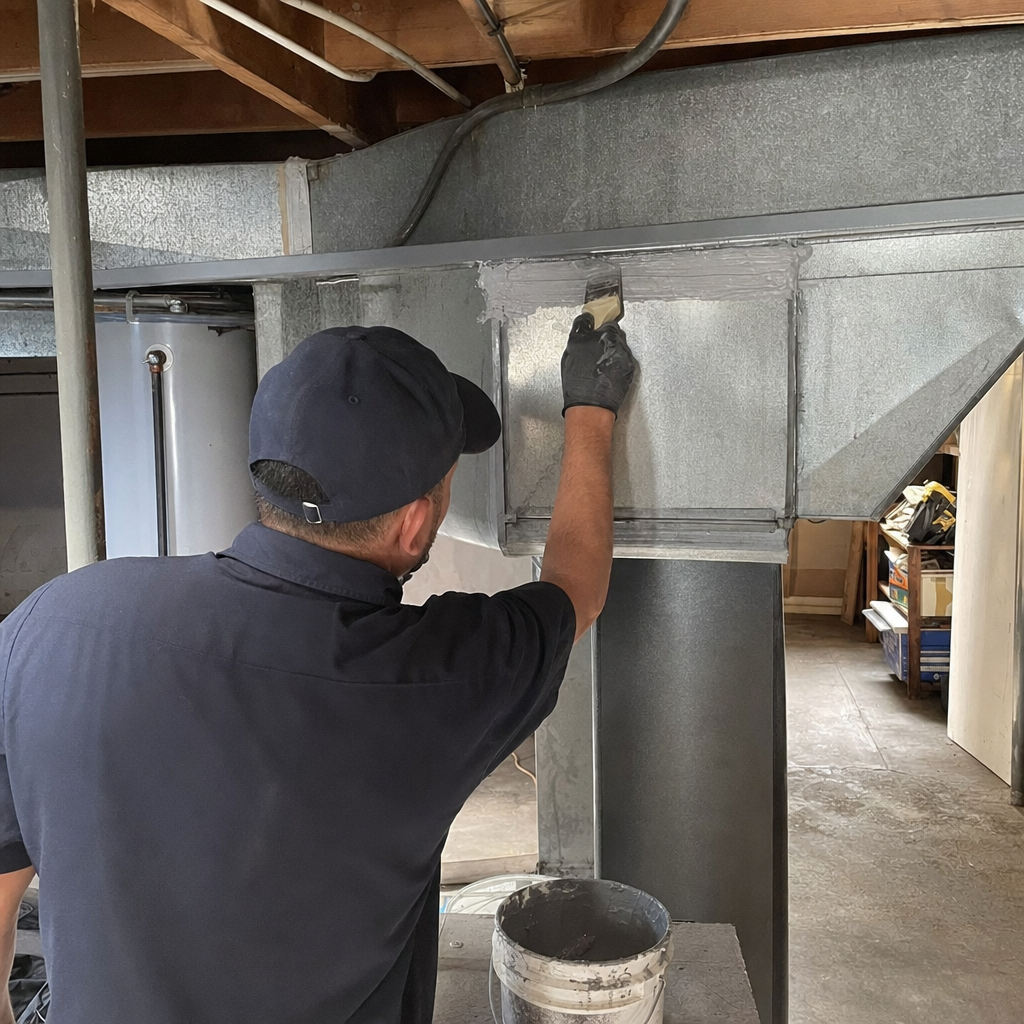
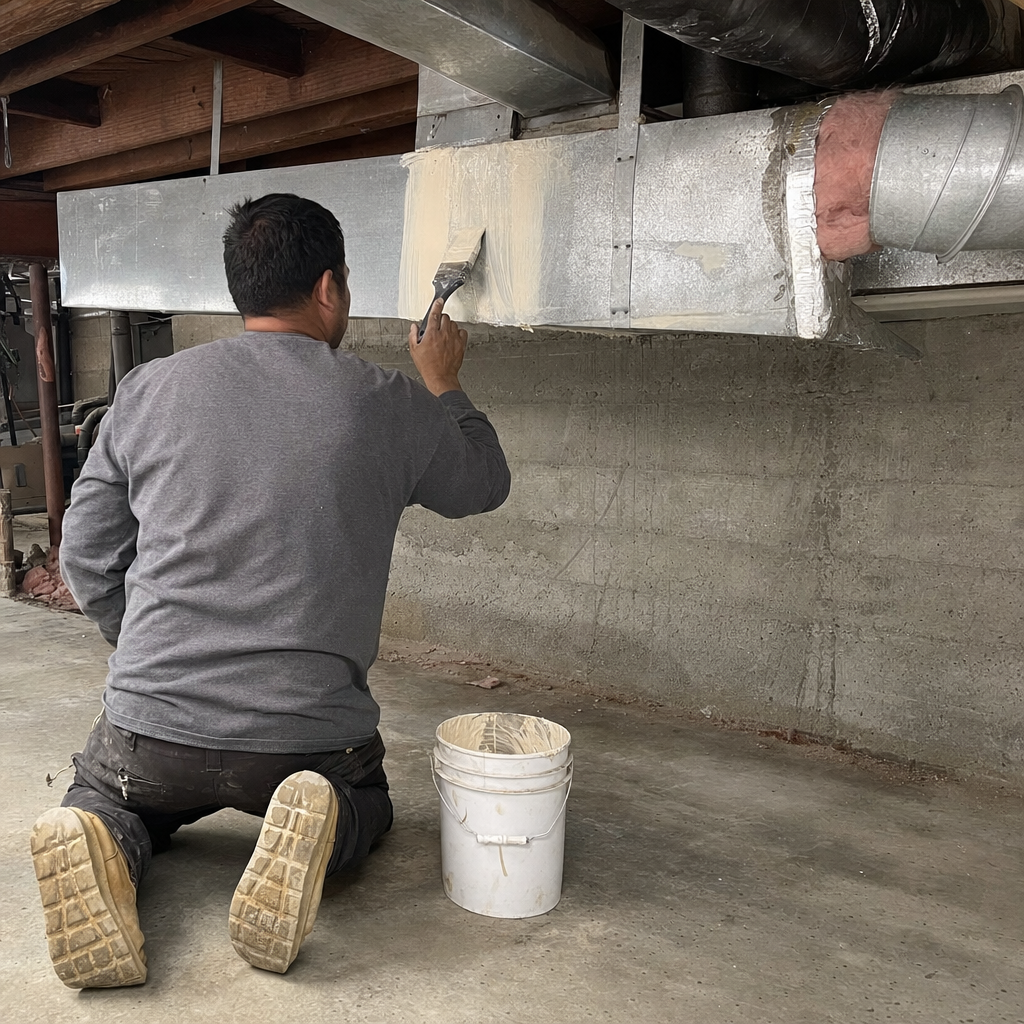
Mastic sealant is the permanent fix for Valley Glen’s most common duct failure: cracked, dried-out seals at trunk-to-branch collars that have been cycling through 150°F attic summers for 60-plus years. We apply a two-coat brush-on mastic system at every metal-to-flex junction, collar fitting, and supply boot — a process that creates a flexible, heat-resistant bond that doesn’t delaminate the way duct tape does under thermal stress. In Valley Glen homes built before 1978, this is frequently the only repair that actually holds through a full summer.

Flex Duct Repair
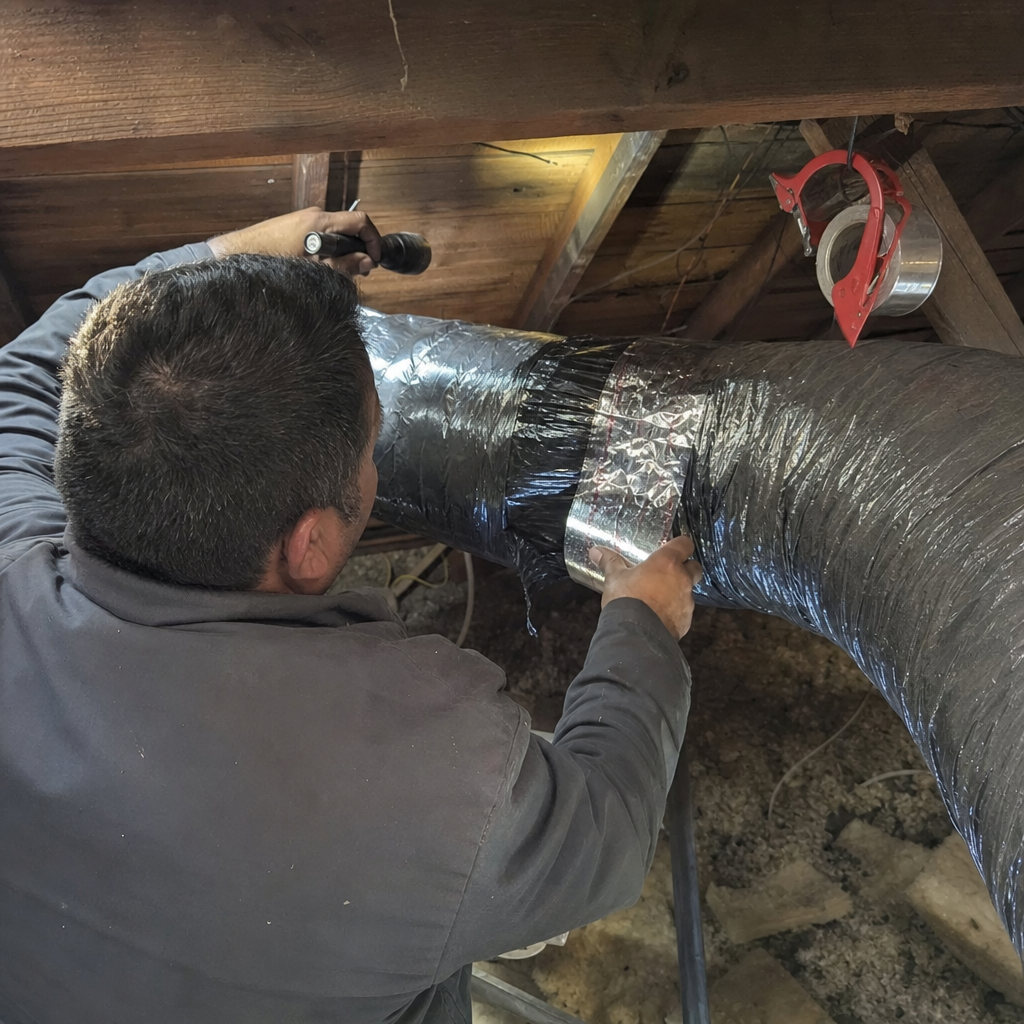
Retrofitted flex-duct branches are everywhere in Valley Glen’s post-WWII ranch homes, and they fail in a predictable way: the inner liner separates from the metal collar, the connection sags, and conditioned air bleeds into the attic instead of reaching the register. We reattach disconnected branches using draw bands and mechanical fasteners — not tape — then seal the collar joint with mastic and restore the vapor barrier wrap. On a single-story stucco ranch, it’s common to find three or four of these in one attic-run system.

Metal Duct Repair (Galvanized Trunk Line)
The original galvanized steel trunk lines running through Valley Glen attics were installed when Eisenhower was president — and some haven’t been touched since. Longitudinal seam separation, crushed sections from attic storage, and corroded collar joints are standard findings on our scoping runs in the 91404 zip code. We patch, re-fasten, and seal using sheet-metal screws and full mastic coating rather than the foil tape that degrades quickly in high-heat attic environments.

Duct Insulation
When flex-duct insulation wrap gets damaged — whether from age, pest activity, or the type of hasty post-quake repairs common in Valley Glen — the duct itself absorbs attic heat rather than delivering cool supply air. We replace degraded wrap with R-6 or R-8 rated flex insulation that meets California Title 24 standards, restoring the thermal separation between your conditioned air and the superheated attic space above. On a ranch home in Valley Glen, re-insulating exposed trunk and branch runs can meaningfully reduce cooling load through summer.

Duct Sealing & Air Leak Repair
Beyond individual connection points, duct systems in older Valley Glen homes often leak at register boots, panned-joist returns, and at transitions between original galvanized trunk and retrofitted flex branches. We pressure-test problem areas and seal systematically — starting at the air handler and working outward — so we’re not guessing at which joints are losing air and which aren’t. This full-system approach is what separates a lasting repair from a temporary patch.

What happens when you call
- 1
A real person answersNo phone trees — you reach a local pro.
- 2
You get an upfront price rangeHonest numbers before anyone is dispatched.
- 3
A background-checked tech heads outLicensed & insured, dispatched right away.
- 4
You approve before work beginsNothing starts until you say go.
Trusted Brands We Service in Valley Glen
Valley Glen homes run a wide generation range of HVAC equipment, and our experience spans it. We work with systems paired to Honeywell thermostats and controls, Aprilaire ventilation and filtration products, and Abatement Technologies air-quality equipment — applying mastic formulations and sealing materials compatible with each. For sanitizing after repair, we use Guardsman products. Our diagnostic work is performed with Rotobrush and Nikro professional systems — industrial-grade tools that give us accurate scope imagery inside trunk lines before we ever pull a panel.
Common Duct Repair & Sealing Problems We See in Valley Glen Homes
- Post-Northridge duct-tape repairs fully delaminated: In Valley Glen, one of the neighborhoods closest to the 1994 Northridge epicenter, technicians regularly find attic flex-duct branches that were re-taped rather than re-clamped during the post-quake repair rush. That tape dried out years ago — what remains is an open gap pulling 150°F attic air and suspended fiberglass fiber directly into the living space every time the blower runs.
- Galvanized trunk-line seams cracked from thermal cycling: The original sheet-metal ductwork in 1950s–1960s Valley Glen ranch homes has cycled through extreme heat — attic temps here regularly exceed 150°F from June through September — and the factory mastic seals at longitudinal seams and collar joints have long since fractured. Conditioned supply air bleeds into the unconditioned attic, and homeowners see the result as high energy bills and uneven room temperatures.
- Santa Ana wind ash packing return-duct seams: Valley Glen sits in the funnel path of Santa Ana wind events that carry concentrated wildfire ash and combustion particulates down through the San Fernando Valley each fall. That fine debris loads return-air duct systems faster here than in beach-adjacent LA neighborhoods, packing seam gaps and accelerating seal degradation at every flex-to-metal junction — particularly on systems that already have compromised mastic.
- Asbestos-containing insulation wrap on pre-1978 duct runs: On Valley Glen homes built before 1978, the original duct insulation wrap may contain asbestos-containing material. This is a realistic find — not a hypothetical — on original galvanized trunk systems in the 91404 area. We scope carefully before any repair work and advise homeowners on appropriate next steps when suspect material is present, before any disturbance occurs.
The Valley Glen Duct Failure Pattern — What We See Street by Street
Valley Glen’s duct problems have a fingerprint. The neighborhood’s residential core is overwhelmingly single-story stucco ranch homes built between 1950 and 1965, with low-pitched roofs and duct systems running through attic cavities that regularly hit 150°F+ from June through September — some of the most severe attic heat loads in Los Angeles County. Those temperatures alone destroy duct-tape bonds and crack dried-out mastic seals faster than in coastal LA neighborhoods that sit 25 degrees cooler on the same July afternoon. But Valley Glen has a second compounding factor that makes it distinct from other San Fernando Valley neighborhoods.
Because Valley Glen falls within the high-shaking zone of the 1994 Northridge earthquake, the post-quake repair rush left a specific legacy: flex-duct branch connections in hundreds of attics were re-taped with standard duct tape rather than properly re-clamped with draw bands and re-sealed with mastic. At the time, the tapes held well enough to pass a visual inspection. Over the following 30 years, the combination of extreme attic heat, seasonal thermal expansion, and normal duct vibration from blower cycles has fully delaminated that tape on most of those connections. What our technicians find — consistently, on Fulton Avenue, near the Oxnard Street corridor, and throughout the ranch-home blocks of the 91404 zip code — are flex branches hanging free from their collars, wide open to the attic.
We were called to exactly this situation on a single-story stucco ranch on Fulton Avenue in Valley Glen. The homeowner had noticed a sharp rise in cooling bills and a recurring fine gray dust coating the supply registers every few weeks. Scoping the attic-run galvanized trunk line, our tech found two flex-duct branch connections that had been re-taped — not re-clamped — after the ’94 quake, with the tape fully delaminated and both branches hanging free, pulling superheated attic air laced with aged fiberglass fiber directly into the living room. We refastened both branches with draw bands, applied two-coat Honeywell-compatible mastic throughout the trunk-to-branch collars, and re-insulated the exposed flex sections before the homeowner’s afternoon AC cycle ran again. One visit. Problem solved at the source.
This earthquake-legacy failure pattern is specific to neighborhoods within the Northridge epicenter radius. It isn’t a meaningful factor in coastal LA communities or eastern San Gabriel Valley homes — but in Valley Glen, it’s part of the standard diagnostic checklist every time we open an attic hatch on a pre-1980 ranch.
Pricing for Duct Repair & Sealing in Valley Glen, CA
Here’s what most Valley Glen homeowners spend on common duct repair and sealing work:
- Mastic sealant application (trunk-to-branch collars, full system): $280–$550
- Flex duct branch repair — per connection (draw band + mastic + vapor wrap): $95–$175 per branch
- Galvanized metal trunk line repair (patching, seam re-sealing): $200–$450 depending on linear footage
- Duct insulation replacement (flex wrap, attic-run sections): $150–$400 per zone
- Full system duct sealing + insulation refresh (typical Valley Glen ranch home): $550–$1,200
What drives cost is the number of compromised connections, the condition of the existing trunk line, and whether asbestos abatement is required before repair work begins on pre-1978 duct insulation. Every job starts with a free estimate — Brandon Flores scopes the attic system, identifies every problem connection, and gives you a number before any work starts. Call (424) 219-7459 to schedule yours.
We Also Serve Cities Near Valley Glen
In addition to Valley Glen, our duct repair and sealing work covers Van Nuys to the west, Sherman Oaks to the south, Encino along the 101 corridor, and North Hills to the northwest. All four share similar post-WWII housing stock and San Fernando Valley attic heat conditions, and we apply the same diagnostic rigor to every job across the region.
Serving Valley Glen, CA — Our Local Coverage Area
We’re based in the Valley Glen area and know this community well. Use the map below to see our service coverage — if you’re nearby, we can almost certainly help.
FAQs — Duct Repair & Sealing in Valley Glen
Yes — and this is one of the most consistent findings on older Valley Glen homes we scope today. In the days and weeks after the ’94 quake, duct connections in attics were commonly re-taped rather than properly re-clamped and mastic-sealed. Standard duct tape holds under normal conditions but degrades rapidly under the thermal cycling of a San Fernando Valley attic — by now, most of that tape has fully delaminated, leaving flex branches disconnected and open to 150°F attic air. If your home is a 1950s–1960s ranch in the 91404 zip code and hasn’t had a professional duct inspection since the quake, there’s a meaningful chance you have open duct gaps in your attic right now. Call (424) 219-7459 for a scoping appointment — Brandon Flores will put a camera in your attic and show you exactly what’s there.
Valley Glen attics hit 150°F or higher during San Fernando Valley summers — while coastal LA neighborhoods sit 20–25 degrees cooler on the same day. That temperature differential matters because every duct seal, mastic joint, and flex-duct connection in your attic is cycling through extreme heat stress repeatedly from June through September, accelerating seal cracking and connection failure far faster than in beach-adjacent communities. An unsealed or poorly sealed duct system in Valley Glen isn’t just mildly inefficient — it’s actively drawing the hottest, dustiest air in Los Angeles directly into your living space every time the blower runs. Sealing those gaps with proper mastic is the only fix that survives the thermal environment here long-term. Call (424) 219-7459 to get an honest assessment of where your system stands.
Yes, and we take this seriously before any work begins on pre-1978 Valley Glen homes. Original duct insulation wrap installed in 1950s and early 1960s construction sometimes contains asbestos-containing material — it’s not universal, but it’s common enough in the 91404 zip code that we scope carefully and flag suspect material before disturbing anything. If we identify material that warrants testing, we advise you on appropriate next steps rather than proceeding with repair work that could create an airborne hazard. We do not charge you to identify the concern. If abatement is required, we’ll tell you clearly what that means for the scope and timeline of the repair. Call (424) 219-7459 and mention your home’s construction era when you schedule.
Scheduling before Santa Ana season — typically September through November — is the smarter move for most Valley Glen homeowners. The dry, high-velocity Santa Ana winds that funnel through the San Fernando Valley carry concentrated wildfire ash and fine combustion particulates that load directly into your return-air duct system. If your duct seams are already compromised, that debris packs into gaps and accelerates seal failure throughout the system. Getting your mastic application and flex-duct repairs completed before those events hit means your system is sealed before it takes on that additional particle load. Call (424) 219-7459 — late summer is a practical window to get ahead of fall wind season.
Mastic is a brush-on compound that cures into a permanently flexible, heat-resistant bond at every collar, seam, and joint it covers — it moves with the metal as it expands and contracts through temperature cycles without cracking or peeling. Duct tape, even foil-faced tape, uses a pressure-sensitive adhesive that breaks down under repeated heat exposure; in Valley Glen attics that hit 150°F every summer, that adhesion fails within a few years at most. We’ve scoped dozens of Valley Glen attics where tape applied in the post-Northridge repair rush has fully delaminated — the tape is still visible, but the connection beneath it is wide open. Mastic, applied properly over mechanical fasteners, is the repair that actually lasts in this climate. Call (424) 219-7459 to schedule a scoping visit and see exactly what your system needs.
Reviewed by Brandon Flores, Owner & Lead Technician at Certified Air Duct Specialists North Hollywood, serving Valley Glen, CA and the San Fernando Valley for 19 years.
